
What Expenses Can Your Startup Claim Before Incorporation?
A practical guide to income tax, GST and founder reimbursement for Indian startups | October 2026
Almost every startup starts spending before it legally exists. A founder pays for a domain on a personal card, a lawyer drafts a founders’ agreement, a freelancer builds the first prototype, and only weeks later does the Certificate of Incorporation arrive. The obvious question follows: can the company claim any of this?
The short answer is yes, partly. Some costs can be written off for tax over five years, some become assets, and GST credit is mostly lost for the pre-registration period. This guide walks through each question founders ask, using the law as it stands today. The Income-tax Act, 2025 replaced the 1961 Act from 1 April 2026, so section numbers for both are given.
1. What are pre-incorporation expenses?
Pre-incorporation expenses are costs incurred by the founders or promoters before the company is legally formed, meaning before the date on the Certificate of Incorporation. Until that date the company is not a legal person. It cannot sign contracts, hold a bank account or be named on an invoice, so someone else has to pay.
Typical examples:
- Name search and reservation, incorporation filing, ROC fees and stamp duty
- Drafting the Memorandum and Articles of Association and the founders’ agreement
- Professional fees of a CA, CS or lawyer for incorporation
- Feasibility study, project report or market survey
- Domain name, logo, trademark search or filing, website and MVP development
- Software subscriptions, co-working rent, travel and pre-launch marketing
Two terms matter here and are often confused. Pre-incorporation is about the legal birth of the entity. Pre-commencement is about when the business actually starts operating. Tax law cares mainly about the second.
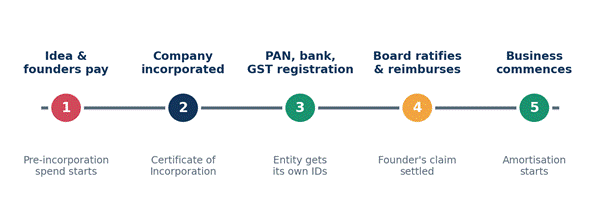
Figure 1: The usual journey of a pre-incorporation expense, from founder payment to settlement.
2. Which expenses can a startup claim before incorporation?
Strictly speaking, the company claims nothing before it exists. What it can do is take over the costs after incorporation, ratify them by board resolution, and then claim whatever the tax law allows. How each cost is treated depends on its nature.
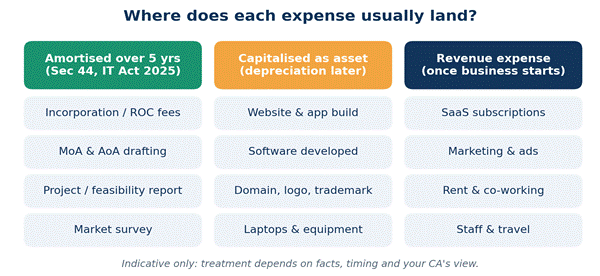
Figure 2: Indicative landing spot for common startup expenses.
| Expense | Usual income-tax treatment | Comment |
| Incorporation and ROC fees | Preliminary expense, amortised over 5 years (Sec 35D old / Sec 44 new) | Subject to the overall cap and Form 5 reporting |
| MoA / AoA drafting, legal fees | Preliminary expense if tied to setting up the business | Keep the engagement letter and invoice |
| Feasibility / project report, market survey | Preliminary expense, amortised over 5 years | Must relate to setting up the business |
| Website, app, software built | Usually capitalised as an intangible asset; depreciation after use begins | Capital vs revenue is fact-specific |
| Domain, logo, trademark | Usually capitalised as an intangible asset | Depreciation as per the Act’s rates |
| SaaS, rent, travel, marketing | Revenue in nature; deductible once the business is set up | Pre-commencement spend is often capitalised or carried forward as pre-operative cost |
3. Are company registration, legal and professional fees tax deductible?
Yes, but not in one go. Under Section 35D of the Income-tax Act, 1961, certain preliminary expenses are written off in five equal yearly instalments instead of being claimed in full. The Income-tax Act, 2025 carries this forward as Section 44, titled “Amortisation of certain preliminary expenses”.
What is covered
- Preparing a feasibility report, project report, market survey or engineering services connected with the business
- Legal charges for drafting agreements relating to the setting up of the business
- For a company: drafting and printing the MoA and AoA, and registration fees under the Companies Act
- Expenses on a public issue of shares or debentures, where applicable
How the deduction works
- One-fifth of the eligible amount is deducted each year for five successive years, starting from the year the business commences (or the extension is completed).
- A ceiling applies. Under the 1961 Act the eligible total could not exceed 5% of the cost of the project, or, at an Indian company’s option, 5% of capital employed. Check the exact wording of Section 44 with your adviser, since the new Act re-drafted parts of this provision.
- The claim is supported by a statement of the expenses. Under the new framework this is Form 5, furnished under Section 44(3) read with Rule 27, per the Income Tax Department’s FAQs, and it is due one month before the due date for filing the return.
A worked example
Suppose your company spends ₹3,00,000 on incorporation, legal drafting and a market survey, and the ceiling works out to ₹10,00,000. The whole ₹3,00,000 is eligible. Business starts in tax year 2026-27.
| Year | Deduction (1/5th) | Unclaimed balance |
| Year 1 (2026-27) | ₹60,000 | ₹2,40,000 |
| Year 2 | ₹60,000 | ₹1,80,000 |
| Year 3 | ₹60,000 | ₹1,20,000 |
| Year 4 | ₹60,000 | ₹60,000 |
| Year 5 | ₹60,000 | Nil |
Two cautions. First, tax authorities and tribunals have argued over whether a given cost is a 35D preliminary expense or an ordinary expense under Section 37(1), and several 2025 and 2026 tribunal matters turn on exactly this. Second, book accounting differs from tax. Under AS 26 and Ind AS 38, start-up costs such as legal and secretarial charges for forming the entity are generally expensed when incurred, so expect a timing difference between your books and your tax computation.
4. Can founders claim expenses for software, website development and marketing?
Founders cannot claim these personally as a business deduction, because the business is the company’s. What they can do is get reimbursed by the company, and then the company decides the tax treatment.
- Website and software development: where the build gives lasting benefit, such as a platform or app, it is generally an intangible asset that is capitalised and depreciated once put to use. Routine hosting or small fixes after launch are revenue expenses.
- Domain names, logo and trademark: typically intangible assets. They are not on the preliminary expense list, so do not assume the five-year write-off applies.
- Marketing and advertising: ordinary promotion after the business starts is a deductible revenue expense. Spend on brand creation before launch is the grey area, and treatment varies with facts.
- SaaS tools, rent and travel: revenue in nature. Whether they are claimed immediately or treated as pre-operative cost depends on whether the business had been set up when they were incurred.
The principle that keeps coming back is the difference between a business being set up and commenced. Expenses after set-up are revenue deductions. Expenses before it are usually capital or pre-operative, unless a special provision like Section 44 lets you spread them.
5. How to record and reimburse pre-incorporation expenses paid by founders
Good paperwork is the difference between a clean claim and a notice. A sensible sequence:
- Track from day one. Keep a simple sheet of date, vendor, amount, purpose and who paid, with every invoice and payment proof.
- Bill in the right name where you can. Once a PAN and GSTIN exist, ask vendors to invoice the company. For earlier spend, invoices will carry the founder’s name, and that is acceptable for reimbursement.
- Ratify after incorporation. Pass a board resolution that the company adopts the pre-incorporation contracts and expenses, lists them, and approves reimbursement. The Specific Relief Act, 1963 recognises the company’s right to adopt promoters’ contracts once formed, subject to its terms.
- Record the liability. Book the costs in the company’s accounts in the right heads (preliminary expense, asset, or expense) with a credit to “Amount due to founder”.
- Choose how to settle. Options include paying the founder back from company funds, treating it as a founder loan, or adjusting it against share allotment. Each has its own compliance, such as the director-loan declaration or private placement rules, so decide with your CS or CA.
- Check TDS and cash rules. Where the company reimburses a vendor payment, confirm whether TDS applied, and note that large cash payments can attract disallowance under the Act.
Reimburse only what you can prove. Costs without invoices, or personal spending mixed in, are the first things an auditor or assessing officer will challenge.
6. GST input tax credit on pre-incorporation expenses: eligibility and conditions
This is where startups are most often disappointed. GST credit is available to a registered person on supplies used for business, and the invoice must be in that person’s name. A company that is not yet incorporated or registered cannot hold either, so credit on pre-registration purchases is mostly unavailable.
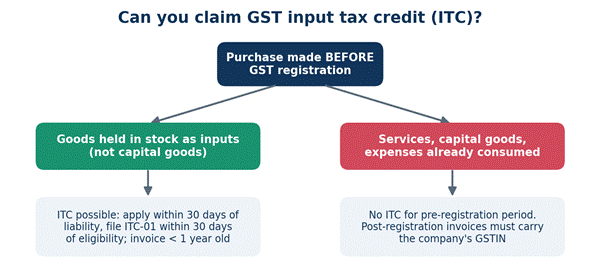
Figure 3: GST credit decision for purchases made before registration.
The narrow exception: Section 18(1)(a) of the CGST Act
If you apply for registration within 30 days of becoming liable and are granted it, you can take credit on inputs held in stock, and on inputs inside semi-finished or finished goods held in stock, as on the day before you became liable to pay tax. Conditions:
- It covers goods, not services. Credit on input services and, under this clause, capital goods is not available for the pre-registration period.
- File Form GST ITC-01 within 30 days of becoming eligible. If it is not filed, the credit is not allowed.
- The tax invoice must be no more than one year old (Section 18(2)).
- Voluntary registrants can claim credit on stock held the day before registration is granted, under Section 18(1)(b).
Practical takeaways
- Legal, CA, ROC and website-development services bought before registration: no ITC for that period.
- Time your GST registration early if you will buy significant goods or services, so later invoices carry your GSTIN.
- Even after registration, blocked credits under Section 17(5) and use for personal purposes remain ineligible.
- Registration thresholds and conditions can change, so confirm whether you need compulsory registration or should opt for voluntary registration.
7. Income-tax treatment under the Indian tax law: the summary
| Point | Income-tax Act, 1961 | Income-tax Act, 2025 (from 1 Apr 2026) |
| Preliminary expenses | Section 35D, five equal instalments | Section 44, same five-year amortisation concept |
| Statement for the claim | Form 3AF | Form 5 under Section 44(3), Rule 27 |
| General business expenses | Section 37(1), after business is set up | Equivalent provisions in the new Act |
| Assets like software, trademarks | Capitalised, with depreciation | Capitalised, with depreciation |
| Who it covers | Indian companies and resident non-corporates | Individuals, firms, companies and others claiming under Section 44, per the Department’s FAQs |
Bottom line: claim what the preliminary-expense provision allows, capitalise what builds a lasting asset, deduct ordinary running costs once the business starts, and expect little or no GST credit for the pre-registration period.
Quick checklist for founders
- Keep every invoice and proof of payment from the first rupee spent.
- Incorporate, then get PAN, TAN, bank account and GST registration promptly.
- Pass a ratification and reimbursement resolution at the first board meeting.
- Separate preliminary expenses, assets and revenue costs in your books.
- File Form 5 on time if you claim the Section 44 deduction.
- File ITC-01 within 30 days if you hold eligible stock at registration.
Disclaimer and sources
This article is for general information and is not tax or legal advice. Tax treatment depends on your facts, and the Income-tax Act, 2025 and its rules are new, so confirm specifics with a qualified Chartered Accountant before filing.
Sources consulted: Income Tax Department FAQs on Form 5 and Section 44 of the Income-tax Act, 2025; CBIC GST Input Tax Credit Rules (Rule 40, Form ITC-01); ICMAI GST study material on Section 18 of the CGST Act; Taxmann and TaxGuru commentary on Section 35D and Section 44.
