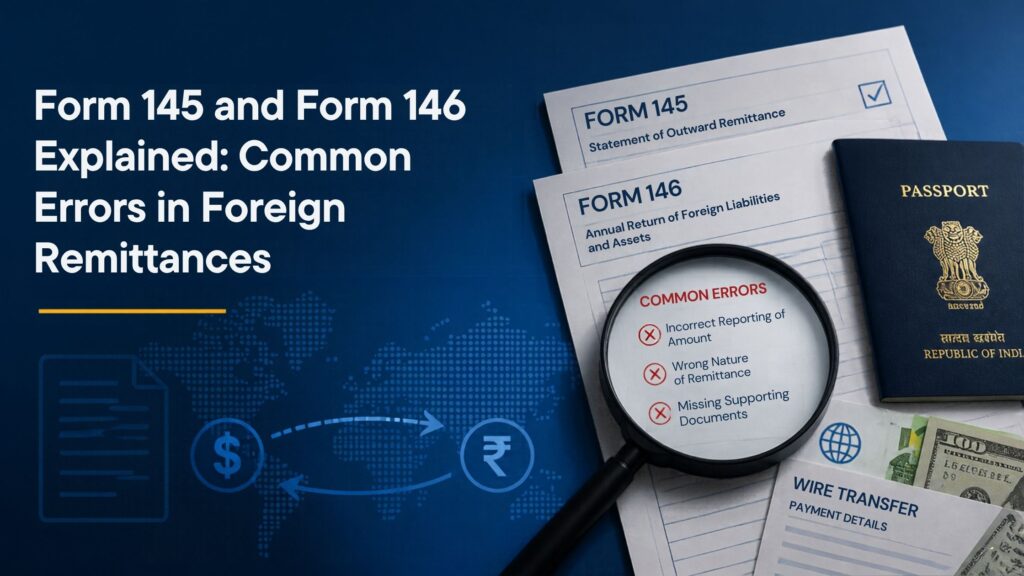
Form 145 and Form 146 Explained: Common Errors in Foreign Remittances
INTRODUCTION
Foreign remittances are a regular part of modern business transactions, whether they involve professional services, software, royalties or other cross-border payments. To ensure compliance with the Income Tax Act and FEMA, taxpayers must meet the prescribed reporting and certification requirements.
Under the Income Tax Rules, 2026, Form 145 and Form 146 have replaced the earlier Forms 15CA and 15CB. However, errors in reporting, tax assessment or documentation can cause delays, penalties and other compliance-related problems. This blog explains the common mistakes and ways to avoid them.
Understanding Form 145 and Form 146
Before looking at common compliance errors, it is essential to understand the purpose of both forms.
Form 145 is a declaration submitted by the person making the foreign remittance. It includes details of the remitter, recipient, payment type, relevant tax provisions and tax deducted at source, wherever applicable.
Form 146 is a certificate issued by a Chartered Accountant after reviewing the remittance, assessing the taxability of the payment, identifying the applicable TDS provisions and certifying compliance with the Income Tax Act.
Together, these forms enable the Income Tax Department to monitor cross-border transactions and ensure that applicable taxes are deducted appropriately.
WHY ACCURATE FOREIGN REMITTANCE COMPLIANCE MATTERS
Foreign remittance compliance involves more than simply submitting a statutory form. Incorrect reporting can create difficulties for both the person making the payment and the recipient.
Non-compliance may lead to:
- Delays in remittance processing by authorised dealer banks
- Interest liability due to short deduction or non-deduction of TDS
- Penalties under the Income Tax Act
- Greater scrutiny by tax authorities
- Complications during future tax assessments
- Additional compliance expenses arising from revised filings
A minor reporting error can turn into a significant expense or compliance issue during a subsequent tax assessment or audit.
COMMON ERRORS IN FORM 145 AND FORM 146
1. Incorrect Classification of the Nature of Remittance
One of the most common mistakes is choosing an incorrect purpose code or providing an inaccurate description of the payment.
Many taxpayers classify payments under broad categories such as professional services or consultancy without properly examining the actual nature of the transaction.
2. Assuming Every Foreign Payment Is Taxable
A frequent misconception is that every payment made to a non-resident is subject to TDS.
In practice, tax must be deducted only when the income is chargeable to tax in India. Depending on the circumstances, certain payments may not be taxable based on:
- The place where the services are performed
- The nature of the income
- The residential status of the recipient
- Relevant provisions of the Income Tax Act
- Applicable DTAA provisions
Unnecessary tax deductions can create complications for both the remitter and the overseas recipient.
3. Ignoring DTAA Benefits
India has entered into Double Taxation Avoidance Agreements (DTAAs) with several countries to prevent the same income from being taxed twice.
However, many businesses apply domestic tax rates without checking whether the relevant DTAA provides a lower tax rate or an exemption.
Overlooking treaty provisions can result in:
- Excessive tax deduction
- Refund claims by foreign recipients
- Additional documentation requirements during assessments
DTAA benefits are available only when the prescribed conditions are satisfied, including the submission of required documents by the non-resident.
4. Applying the Incorrect TDS Rate
Choosing the wrong TDS rate is one of the major compliance risks associated with foreign remittances.
The applicable rate depends on several factors, including:
- Nature of the income
- Relevant section of the Income Tax Act
- Applicable DTAA provisions
- Availability of supporting documents
- Surcharge and cess, wherever applicable
Even a small mistake in selecting the tax rate can lead to short deduction, interest liability and penalties.
5. Filing Forms with Incorrect Information
Simple data entry mistakes in applications can also delay the foreign remittance process.
Some common errors include:
- Incorrect PAN details
- Incorrect Tax Identification Number of the recipient
- Incorrect country of residence
- Errors in the remittance amount
- Differences between the agreement and form details
- Incorrect bank details
Although these mistakes may appear insignificant, they can require corrections or fresh form submissions.
6. Obtaining Form 146 After Initiating the Remittance
Some businesses start the remittance process before approaching a Chartered Accountant for the required certification.
This can create practical challenges because the certificate is intended to support the tax assessment before the remittance is completed.
Late certification may lead to:
- Delays in bank processing
- Requests for additional documents
- Resubmission of forms
- Further compliance-related complications
7. Inadequate Documentation
Maintaining proper documentation is essential for foreign remittance compliance. Some businesses keep only invoices and overlook other supporting records that may be required during an assessment.
The important documents generally include:
- Invoice
- Agreement or contract
- Tax Residency Certificate, wherever applicable
- Form 10F, wherever required
- No Permanent Establishment declaration, wherever applicable
- Chartered Accountant’s working papers
- TDS calculation
- Bank advice and remittance records
Keeping all relevant documents properly organised helps minimise compliance risks.
8. Treating Similar Transactions in the Same Way
Many businesses assume that if a previous payment to a particular vendor was made without TDS, all future payments to the same vendor will receive identical tax treatment.
This assumption can create compliance risks because the taxability of a payment depends on the specific facts and circumstances of each transaction.
Changes in the nature of services, contractual conditions, recipient status or applicable tax provisions can significantly affect the tax treatment.
Therefore, every foreign remittance should be assessed separately instead of relying solely on past practices.
DELAYED FILING OF FORM 145
Many taxpayers prioritise completing the payment and address compliance requirements afterwards. This approach can lead to delays in filing Form 145 and create avoidable difficulties.
Late compliance may result in:
- Delays in remittance processing
- Additional queries from authorised dealer banks
- Higher chances of receiving notices from the tax department
- Interest and penalties, wherever applicable
CONSEQUENCES OF NON-COMPLIANCE
Failure to follow foreign remittance compliance requirements can lead to both financial and legal consequences. Even genuine errors may attract scrutiny when the necessary supporting documents are unavailable.
Some potential consequences include:
- Interest liability due to short deduction or non-deduction of TDS
- Penalties under the Income Tax Act
- Delays in processing foreign remittances
- Higher compliance expenses
- Income tax notices and assessments
- Difficulties during tax audits
Following the prescribed compliance requirements on time helps businesses avoid penalties and maintain confidence during departmental assessments and bank verification.
CONCLUSION
Proper compliance with Form 145 and Form 146 is essential for completing foreign remittances smoothly and in accordance with the Income Tax Rules, 2026. Accurate tax assessment, timely reporting and complete documentation help prevent delays, penalties and unnecessary scrutiny while supporting hassle-free cross-border transactions.
FAQs
Q- What are Form 145 and Form 146?
Form 145 is used for reporting specified foreign remittances made to non-residents or foreign companies, while Form 146 is a Chartered Accountant’s certificate used in specified cases to support the tax treatment of such remittances.
Q- When are Form 145 and Form 146 applicable?
They apply to qualifying remittances made under the current income-tax framework, subject to the applicable conditions, exclusions, thresholds, and reporting requirements.
Q- What is the most common error when filing Form 145?
A common error is selecting the wrong part of Form 145 because the payer has incorrectly determined whether the remittance is taxable, the applicable threshold, or whether a prescribed certificate is available.
Q- What happens if the wrong Form 145 part is selected?
Incorrect classification can result in inaccurate reporting and may create issues with tax deduction, documentation, or subsequent scrutiny. The error should be reviewed and corrected through the applicable procedure.
Q- Is Form 146 required for every foreign remittance?
No. Form 146 is required only in cases where the applicable rules require an accountant’s certificate. Not every foreign remittance requires a CA certificate.
Q- What is a common mistake in determining whether Form 146 is required?
Businesses sometimes assume that every payment above a particular amount automatically requires Form 146 without checking the nature and taxability of the payment or whether an Assessing Officer certificate applies.
Q- Can an incorrect HSN or nature-of-payment classification affect Form 145?
The nature and classification of the payment can affect its taxability and reporting requirements. Businesses should accurately describe the transaction and determine the applicable tax treatment before filing.
Q- What documents should be checked before preparing Form 145?
Businesses should review invoices, agreements, payment details, recipient information, tax residency documents, applicable tax treaty information, and other records relevant to determining taxability.
Q- What information should a CA verify before issuing Form 146?
The CA may review the nature of the remittance, recipient details, applicable domestic tax provisions, DTAA provisions where relevant, tax deduction requirements, and supporting documentation.
Q- Can DTAA benefits be missed while preparing Form 146?
Yes. Businesses may overlook treaty provisions or fail to maintain the required documentation. DTAA benefits should be evaluated based on the recipient’s eligibility and the applicable treaty conditions.
Q- Is a Tax Residency Certificate important for foreign remittances?
A Tax Residency Certificate can be important when treaty benefits are being claimed. Additional documentation may also be required depending on the applicable provisions and circumstances.
Q- Can a foreign remittance be taxable even if the recipient is outside India?
Yes. A payment to a non-resident can be taxable in India depending on the nature of the income, where it arises, applicable domestic law, and any relevant tax treaty.
Q- Is TDS required on every payment made to a foreign company?
No. TDS depends on the taxability of the payment under applicable Indian tax provisions. The nature of the payment and relevant treaty provisions should be evaluated before determining the withholding obligation.
Q- What happens if a business deducts the wrong amount of TDS on a foreign remittance?
Incorrect TDS can create tax compliance issues for the payer, including potential interest and other consequences. The business should review the transaction and take appropriate corrective action.
Q- Can Form 145 be filed without Form 146?
Yes, where the applicable rules permit the relevant Form 145 part to be furnished without a Form 146 certificate. The requirement for Form 146 depends on the circumstances of the remittance.
Q- What are common documentation errors in foreign remittances?
Common issues include missing invoices, incomplete agreements, incorrect recipient details, inadequate tax residency documentation, inconsistent payment descriptions, and insufficient evidence supporting the tax treatment.
Q- Can multiple foreign remittances be covered by one Form 145?
The applicability and filing structure depend on the prescribed form and circumstances. Since Form 145 is an event-based compliance requirement, businesses should determine the appropriate filing for each qualifying remittance.
Q- What happens if Form 145 is not filed before a qualifying remittance?
Failure to complete a required reporting or withholding compliance step can create tax and regulatory issues. The payer should assess the transaction promptly and follow the applicable corrective procedure.
Q- How can businesses avoid errors in Form 145 and Form 146?
Businesses should determine taxability before payment, maintain complete documentation, verify the applicable threshold and form part, evaluate DTAA benefits, and obtain professional review where required.
Q- Can a CA help correct errors in Form 145 and Form 146?
Yes. A CA can review the transaction, identify errors in taxability or documentation, assess TDS and DTAA implications, and guide the business through the applicable correction or compliance process.